
Mastering knee-friendly leg workout is essential for achieving peak physical transformation. Chronic knee pain, patellar tendonitis, meniscus wear, and chondromalacia patellae are among the most debilitating bottlenecks that force home fitness enthusiasts to abandon lower body training completely. Many athletes mistakenly believe that if regular squats or forward lunges cause sharp kneecap discomfort, they must resign themselves to slender, underdeveloped legs for life. In reality, by mastering biomechanical joint redistribution — systematically replacing anterior knee-shear movements with hip-hinge dominance, vertical shin loading, and static time-under-tension — you can execute a highly potent, muscle-building knee friendly legs workout at home that thickens your quadriceps and glutes while leaving your delicate knee joints entirely pain-free.
Mastering knee friendly legs requires an uncompromising commitment to understanding human lower-body biomechanics, optimal training protocols, and evidence-based nutritional strategies. Many home fitness enthusiasts fall victim to commercial shortcuts or misleading advice, yet the actual biological pathways governing physical development follow precise scientific rules that, when understood and applied correctly, produce extraordinary and lasting results.
Throughout this comprehensive guide on knee friendly legs, we will dismantle prevalent fitness myths and provide you with an actionable, step-by-step framework tailored specifically for the Indian lifestyle. Whether your goal is to build massive lower body muscle, fix postural imbalances, overcome training plateaus, or prevent joint injuries, every single instruction detailed below is backed by clinical research and proven athletic protocols used by elite strength coaches and physiotherapists.
Before initiating any intensive protocol for knee friendly legs, it is essential to establish baseline metrics and eliminate daily environmental habits that actively limit your leg development or recovery. By combining strict nutritional saturation, consistent training routines, and optimized recovery practices, you empower your body to express its maximum genetic and epigenetic potential without risk of orthopedic injury or overtraining syndrome.
Knee-friendly Leg Workout: The Biomechanics of Knee Pain: Anterior Shear vs. Posterior Chain Distribution
To train legs hard without knee joint discomfort, you must understand the exact mechanical force causing your pain: Anterior Shear Stress. When you perform forward lunges, deep narrow-stance squats, or jump squats, your knee joint travels significantly forward over your toes while bearing heavy loads. This forward knee travel pushes the patella (kneecap) backward against the femur with tremendous friction while subjecting the patellar tendon and anterior cruciate ligament (ACL) to high anterior shearing forces.
You permanently bypass anterior shear stress by adhering to two biomechanical rules: Vertical Shin Enforcement and Posterior Chain Redistribution. When your shin bone (tibia) remains perfectly vertical perpendicular to the floor during lower body movements (such as during reverse lunges, glute bridges, or box squats), anterior shear forces across the kneecap drop to nearly zero. The mechanical braking and lifting forces are shifted directly into your powerful, joint-safe posterior muscles: the gluteus maximus and hamstrings.

Anterior Patellar Shear Stress Explained
To fully execute Anterior Patellar Shear Stress Explained effectively, you must maintain uncompromised technical discipline and understand the underlying physiological mechanism. Why forward knee travel over toes compresses the kneecap against the thigh bone and triggers patellar tendon irritation. When executed consistently over a 60-to-90-day training cycle, this specific protocol forces profound structural adaptation, strengthening the surrounding connective tissues, improving localized vascularity, and enhancing neuromuscular coordination across the target leg muscle groups.
Furthermore, integrating Anterior Patellar Shear Stress Explained into your daily routine provides a direct competitive advantage over generic training programs. By focusing on progressive overload, strict time-under-tension, and optimal joint alignment during knee friendly legs, you eliminate common biomechanical bottlenecks and accelerate your body natural recovery capacity. Ensure that every repetition or static hold is performed with deliberate breathing and full range of motion to capture 100% of the anatomical benefits.
The Vertical Shin Safety Angle
To fully execute The Vertical Shin Safety Angle effectively, you must maintain uncompromised technical discipline and understand the underlying physiological mechanism. Keeping your shin bone 90 degrees perpendicular to the floor to completely eliminate anterior shearing across knee joints. When executed consistently over a 60-to-90-day training cycle, this specific protocol forces profound structural adaptation, strengthening the surrounding connective tissues, improving localized vascularity, and enhancing neuromuscular coordination across the target leg muscle groups.
Furthermore, integrating The Vertical Shin Safety Angle into your daily routine provides a direct competitive advantage over generic training programs. By focusing on progressive overload, strict time-under-tension, and optimal joint alignment during knee friendly legs, you eliminate common biomechanical bottlenecks and accelerate your body natural recovery capacity. Ensure that every repetition or static hold is performed with deliberate breathing and full range of motion to capture 100% of the anatomical benefits.
Posterior Chain Load Redistribution
To fully execute Posterior Chain Load Redistribution effectively, you must maintain uncompromised technical discipline and understand the underlying physiological mechanism. Shifting 80 percent of mechanical lifting torque directly into your thick glutes and hamstrings to protect vulnerable knees. When executed consistently over a 60-to-90-day training cycle, this specific protocol forces profound structural adaptation, strengthening the surrounding connective tissues, improving localized vascularity, and enhancing neuromuscular coordination across the target leg muscle groups.
Furthermore, integrating Posterior Chain Load Redistribution into your daily routine provides a direct competitive advantage over generic training programs. By focusing on progressive overload, strict time-under-tension, and optimal joint alignment during knee friendly legs, you eliminate common biomechanical bottlenecks and accelerate your body natural recovery capacity. Ensure that every repetition or static hold is performed with deliberate breathing and full range of motion to capture 100% of the anatomical benefits.
Low-Impact Quad Builder 1: Box Squats to a Chair & Reverse Lunges
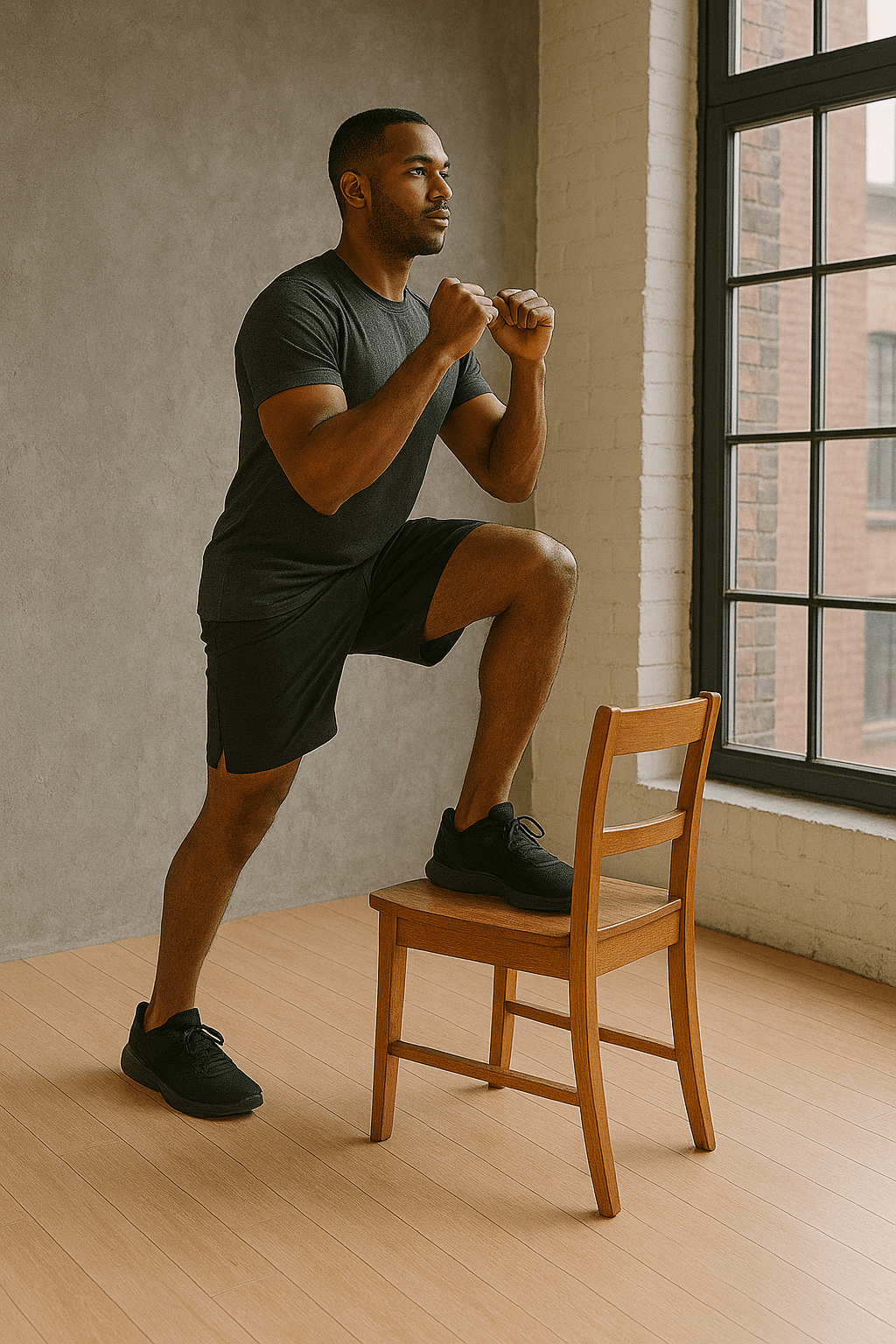
The Box Squat and the Reverse Lunge are the two premier joint-safe compound movements that build dense quadriceps and glutes without stressing the patellar tendon. For the Box Squat: place a sturdy dining chair or sofa behind you. Stand with a wide, hip-width stance with your toes pointed slightly outward at 30 degrees. Instead of bending your knees forward to descend, push your hips straight backward toward the chair as if reaching for a seat far behind you until your glutes touch the pad. Pause completely on the chair for 1 second to eliminate momentum, then drive through your heels to stand tall.
For the Reverse Lunge: unlike forward lunges where your body momentum slams forward into your front knee, the Reverse Lunge involves taking a long, deliberate step backward behind you. Because your body weight shifts backward, your front working shin remains locked in a safe, vertical position perpendicular to the floor. Lower your back knee gently until it hovers 1 inch off the carpet, then drive through your front heel to step back to standing. Your quads receive intense, muscle-building tension with zero knee friction.

Box Squat Hip-Hinge Initiation Mechanics
To fully execute Box Squat Hip-Hinge Initiation Mechanics effectively, you must maintain uncompromised technical discipline and understand the underlying physiological mechanism. Pushing hips straight backward to a chair to ensure knees never travel forward of toes during the entire squat descent. When executed consistently over a 60-to-90-day training cycle, this specific protocol forces profound structural adaptation, strengthening the surrounding connective tissues, improving localized vascularity, and enhancing neuromuscular coordination across the target leg muscle groups.
Furthermore, integrating Box Squat Hip-Hinge Initiation Mechanics into your daily routine provides a direct competitive advantage over generic training programs. By focusing on progressive overload, strict time-under-tension, and optimal joint alignment during knee friendly legs, you eliminate common biomechanical bottlenecks and accelerate your body natural recovery capacity. Ensure that every repetition or static hold is performed with deliberate breathing and full range of motion to capture 100% of the anatomical benefits.
Reverse Lunge Backward-Momentum Physics
To fully execute Reverse Lunge Backward-Momentum Physics effectively, you must maintain uncompromised technical discipline and understand the underlying physiological mechanism. Why stepping backward eliminates the traumatic braking impact on the front kneecap associated with forward lunges. When executed consistently over a 60-to-90-day training cycle, this specific protocol forces profound structural adaptation, strengthening the surrounding connective tissues, improving localized vascularity, and enhancing neuromuscular coordination across the target leg muscle groups.
Furthermore, integrating Reverse Lunge Backward-Momentum Physics into your daily routine provides a direct competitive advantage over generic training programs. By focusing on progressive overload, strict time-under-tension, and optimal joint alignment during knee friendly legs, you eliminate common biomechanical bottlenecks and accelerate your body natural recovery capacity. Ensure that every repetition or static hold is performed with deliberate breathing and full range of motion to capture 100% of the anatomical benefits.
Dead-Stop Chair Pause Technique
To fully execute Dead-Stop Chair Pause Technique effectively, you must maintain uncompromised technical discipline and understand the underlying physiological mechanism. Resting on the chair box for 1 full second to kill elastic tendon recoil and force pure muscular lifting from a dead stop. When executed consistently over a 60-to-90-day training cycle, this specific protocol forces profound structural adaptation, strengthening the surrounding connective tissues, improving localized vascularity, and enhancing neuromuscular coordination across the target leg muscle groups.
Furthermore, integrating Dead-Stop Chair Pause Technique into your daily routine provides a direct competitive advantage over generic training programs. By focusing on progressive overload, strict time-under-tension, and optimal joint alignment during knee friendly legs, you eliminate common biomechanical bottlenecks and accelerate your body natural recovery capacity. Ensure that every repetition or static hold is performed with deliberate breathing and full range of motion to capture 100% of the anatomical benefits.
Low-Impact Glute Builder 2: Sofa Hip Thrusts & Single-Leg Glute Bridges
When knee flexion movements must be restricted to protect sensitive joints, direct hip extension becomes your primary driver for lower body mass accumulation. The Sofa Hip Thrust and Single-Leg Floor Glute Bridge subject your gluteus maximus and upper hamstrings to heavy, hypertrophic mechanical loads while keeping your knee joint locked at a stable, isometric 90-degree angle where zero cartilage friction occurs.
For Sofa Hip Thrusts: rest your upper back across the edge of your couch, plant both feet shoulder-width apart firmly on the floor directly beneath your knees, and place a heavy backpack loaded with 20 to 35 kilograms of books directly across your pelvic crease. Drive through your heels to bridge your hips up until your torso and thighs form a flat table top, squeezing your glutes with maximal force for 2 strict seconds at the top before lowering cleanly over 3 seconds. Perform 4 sets of 15 reps for an extraordinary, pain-free posterior pump.

Static 90-Degree Knee Joint Angle
To fully execute Static 90-Degree Knee Joint Angle effectively, you must maintain uncompromised technical discipline and understand the underlying physiological mechanism. Why locking the knee at exactly 90 degrees during hip thrusts completely prevents patellar cartilage rubbing and pain. When executed consistently over a 60-to-90-day training cycle, this specific protocol forces profound structural adaptation, strengthening the surrounding connective tissues, improving localized vascularity, and enhancing neuromuscular coordination across the target leg muscle groups.
Furthermore, integrating Static 90-Degree Knee Joint Angle into your daily routine provides a direct competitive advantage over generic training programs. By focusing on progressive overload, strict time-under-tension, and optimal joint alignment during knee friendly legs, you eliminate common biomechanical bottlenecks and accelerate your body natural recovery capacity. Ensure that every repetition or static hold is performed with deliberate breathing and full range of motion to capture 100% of the anatomical benefits.
Backpack Pelvic Loading for Heavy Resistance
To fully execute Backpack Pelvic Loading for Heavy Resistance effectively, you must maintain uncompromised technical discipline and understand the underlying physiological mechanism. Resting up to 35 kilograms of household weights across your hips to overload the gluteus maximus safely at home. When executed consistently over a 60-to-90-day training cycle, this specific protocol forces profound structural adaptation, strengthening the surrounding connective tissues, improving localized vascularity, and enhancing neuromuscular coordination across the target leg muscle groups.
Furthermore, integrating Backpack Pelvic Loading for Heavy Resistance into your daily routine provides a direct competitive advantage over generic training programs. By focusing on progressive overload, strict time-under-tension, and optimal joint alignment during knee friendly legs, you eliminate common biomechanical bottlenecks and accelerate your body natural recovery capacity. Ensure that every repetition or static hold is performed with deliberate breathing and full range of motion to capture 100% of the anatomical benefits.
The 2-Second Top Isometric Glute Squeeze
To fully execute The 2-Second Top Isometric Glute Squeeze effectively, you must maintain uncompromised technical discipline and understand the underlying physiological mechanism. Squeezing your glutes at peak extension for 2 full seconds to maximize myofibrillar recruitment without knee movement. When executed consistently over a 60-to-90-day training cycle, this specific protocol forces profound structural adaptation, strengthening the surrounding connective tissues, improving localized vascularity, and enhancing neuromuscular coordination across the target leg muscle groups.
Furthermore, integrating The 2-Second Top Isometric Glute Squeeze into your daily routine provides a direct competitive advantage over generic training programs. By focusing on progressive overload, strict time-under-tension, and optimal joint alignment during knee friendly legs, you eliminate common biomechanical bottlenecks and accelerate your body natural recovery capacity. Ensure that every repetition or static hold is performed with deliberate breathing and full range of motion to capture 100% of the anatomical benefits.
Low-Impact Quad Builder 3: Isometric Wall Sits & Straight-Leg Raises
If even box squats or reverse lunges cause mild joint irritation during acute flare-ups, you can still build and preserve thick quadriceps muscle tissue using pure Isometric Wall Sits and Weighted Straight-Leg Raises. Clinical rehabilitation studies prove that static isometric holds trigger massive muscle fiber recruitment and tendon analgesia (pain relief) without requiring the joint to move through a painful range of motion.
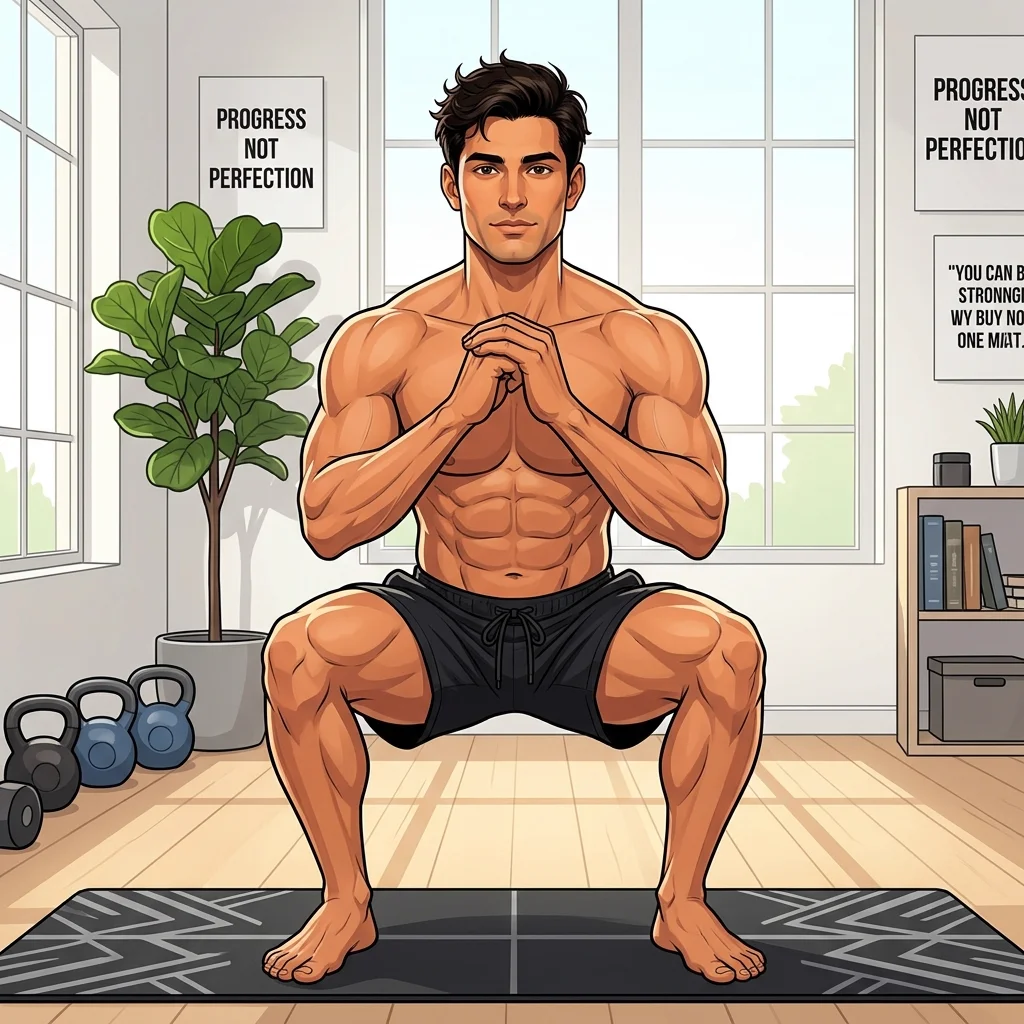
For Isometric Wall Sits: lean your back flat against your living room wall and slide down until your thighs are parallel to the floor (or slightly above if 90 degrees causes pain), ensuring your shins are strictly vertical. Hold this static position for 45 to 60 seconds, pressing your heels firmly into the floor until your quadriceps burn and shake. For Seated Straight-Leg Raises: sit on the floor with one leg straight out, attach a light ankle weight or loop a resistance band around your foot, and lift your straight leg 12 inches into the air, holding for 3 seconds to intensely isolate the vastus medialis teardrop muscle.

Isometric Tendon Analgesia & Pain Relief
To fully execute Isometric Tendon Analgesia & Pain Relief effectively, you must maintain uncompromised technical discipline and understand the underlying physiological mechanism. How 45-second static wall sits actively reduce knee joint pain signals while recruiting high-threshold muscle fibers. When executed consistently over a 60-to-90-day training cycle, this specific protocol forces profound structural adaptation, strengthening the surrounding connective tissues, improving localized vascularity, and enhancing neuromuscular coordination across the target leg muscle groups.
Furthermore, integrating Isometric Tendon Analgesia & Pain Relief into your daily routine provides a direct competitive advantage over generic training programs. By focusing on progressive overload, strict time-under-tension, and optimal joint alignment during knee friendly legs, you eliminate common biomechanical bottlenecks and accelerate your body natural recovery capacity. Ensure that every repetition or static hold is performed with deliberate breathing and full range of motion to capture 100% of the anatomical benefits.
Vastus Medialis Teardrop Conditioning
To fully execute Vastus Medialis Teardrop Conditioning effectively, you must maintain uncompromised technical discipline and understand the underlying physiological mechanism. Using straight-leg raises to strengthen the inner teardrop muscle that tracks the kneecap safely inside its femoral groove. When executed consistently over a 60-to-90-day training cycle, this specific protocol forces profound structural adaptation, strengthening the surrounding connective tissues, improving localized vascularity, and enhancing neuromuscular coordination across the target leg muscle groups.
Furthermore, integrating Vastus Medialis Teardrop Conditioning into your daily routine provides a direct competitive advantage over generic training programs. By focusing on progressive overload, strict time-under-tension, and optimal joint alignment during knee friendly legs, you eliminate common biomechanical bottlenecks and accelerate your body natural recovery capacity. Ensure that every repetition or static hold is performed with deliberate breathing and full range of motion to capture 100% of the anatomical benefits.
Pain-Free Angle Customization
To fully execute Pain-Free Angle Customization effectively, you must maintain uncompromised technical discipline and understand the underlying physiological mechanism. Adjusting your wall sit depth from 90 degrees up to 110 degrees to ensure 100 percent comfortable, pain-free execution. When executed consistently over a 60-to-90-day training cycle, this specific protocol forces profound structural adaptation, strengthening the surrounding connective tissues, improving localized vascularity, and enhancing neuromuscular coordination across the target leg muscle groups.
Furthermore, integrating Pain-Free Angle Customization into your daily routine provides a direct competitive advantage over generic training programs. By focusing on progressive overload, strict time-under-tension, and optimal joint alignment during knee friendly legs, you eliminate common biomechanical bottlenecks and accelerate your body natural recovery capacity. Ensure that every repetition or static hold is performed with deliberate breathing and full range of motion to capture 100% of the anatomical benefits.
The Complete 35-Minute Pain-Free Home Leg Routine
To assemble these low-impact, joint-safe movements into a highly effective muscle-building session, execute this complete 35-minute knee-friendly routine exactly 2 days per week (for example, Monday and Thursday). Always begin with 3 minutes of gentle hip circles and glute bridges to warm up your lower body joints.
Routine Flow: Exercise 1: Box Squats to a Chair holding a water jug — 4 sets of 15 reps with 1-second dead-stop chair pause (rest 60s); Exercise 2: Alternating Reverse Lunges — 3 sets of 20 total continuous steps (10 per leg) with strict vertical shin alignment (rest 60s); Exercise 3: Loaded Backpack Sofa Hip Thrusts — 4 sets of 15 strict reps with 2-second top squeeze (rest 60s); Exercise 4: Isometric Wall Sits — 3 all-out sets holding for 45 to 60 seconds to complete quad fatigue (rest 60s); Exercise 5: Seated Straight-Leg Raises — 3 sets of 15 reps per leg holding 3 seconds at top (rest 45s). Your legs will grow remarkably thick without a single twinge of knee pain.

Chronological 5-Exercise Pain-Free Flow
To fully execute Chronological 5-Exercise Pain-Free Flow effectively, you must maintain uncompromised technical discipline and understand the underlying physiological mechanism. Combining chair box squats, reverse lunges, backpack hip thrusts, static wall sits, and straight-leg teardrop raises. When executed consistently over a 60-to-90-day training cycle, this specific protocol forces profound structural adaptation, strengthening the surrounding connective tissues, improving localized vascularity, and enhancing neuromuscular coordination across the target leg muscle groups.
Furthermore, integrating Chronological 5-Exercise Pain-Free Flow into your daily routine provides a direct competitive advantage over generic training programs. By focusing on progressive overload, strict time-under-tension, and optimal joint alignment during knee friendly legs, you eliminate common biomechanical bottlenecks and accelerate your body natural recovery capacity. Ensure that every repetition or static hold is performed with deliberate breathing and full range of motion to capture 100% of the anatomical benefits.
Strict Vertical Shin Enforcement Checklist
To fully execute Strict Vertical Shin Enforcement Checklist effectively, you must maintain uncompromised technical discipline and understand the underlying physiological mechanism. Verifying on every single repetition that your front knee never drifts forward past your shoe laces during exercise. When executed consistently over a 60-to-90-day training cycle, this specific protocol forces profound structural adaptation, strengthening the surrounding connective tissues, improving localized vascularity, and enhancing neuromuscular coordination across the target leg muscle groups.
Furthermore, integrating Strict Vertical Shin Enforcement Checklist into your daily routine provides a direct competitive advantage over generic training programs. By focusing on progressive overload, strict time-under-tension, and optimal joint alignment during knee friendly legs, you eliminate common biomechanical bottlenecks and accelerate your body natural recovery capacity. Ensure that every repetition or static hold is performed with deliberate breathing and full range of motion to capture 100% of the anatomical benefits.
The 0/10 Pain Threshold Rule
To fully execute The 0/10 Pain Threshold Rule effectively, you must maintain uncompromised technical discipline and understand the underlying physiological mechanism. Why you must modify depth or weight immediately if an exercise ever exceeds a 0/10 knee joint discomfort level. When executed consistently over a 60-to-90-day training cycle, this specific protocol forces profound structural adaptation, strengthening the surrounding connective tissues, improving localized vascularity, and enhancing neuromuscular coordination across the target leg muscle groups.
Furthermore, integrating The 0/10 Pain Threshold Rule into your daily routine provides a direct competitive advantage over generic training programs. By focusing on progressive overload, strict time-under-tension, and optimal joint alignment during knee friendly legs, you eliminate common biomechanical bottlenecks and accelerate your body natural recovery capacity. Ensure that every repetition or static hold is performed with deliberate breathing and full range of motion to capture 100% of the anatomical benefits.
Indian Anti-Inflammatory Diet & Collagen Matrix for Knee Healing
While your joint-safe training routine protects your knees from acute mechanical irritation, your nutritional strategy must actively repair damaged cartilage, strengthen patellar tendons, and suppress chronic systemic inflammation. Cartilage is bloodless tissue that relies entirely on nutrient diffusion from synovial joint fluid.
Consume a daily morning cup of Haldi Doodh (warm whole milk with 1 teaspoon organic turmeric and black pepper) along with 1 gram of Vitamin C from fresh amla juice paired with 15 grams of gelatin or whey protein 45 minutes prior to your workout to drive targeted collagen synthesis into your knee tendons. For dinner, consume traditional Indian anti-inflammatory meals like bone broth (or black chana curry with garlic and ginger) paired with 300g paneer or chicken breast and white rice to supply the 1.8g/kg daily protein required for robust myofibrillar leg hypertrophy.

Pre-Workout Amla Vitamin C & Collagen Matrix
To fully execute Pre-Workout Amla Vitamin C & Collagen Matrix effectively, you must maintain uncompromised technical discipline and understand the underlying physiological mechanism. Consuming Indian amla juice and protein 45 minutes pre-workout to stimulate collagen cross-linking inside knee tendons. When executed consistently over a 60-to-90-day training cycle, this specific protocol forces profound structural adaptation, strengthening the surrounding connective tissues, improving localized vascularity, and enhancing neuromuscular coordination across the target leg muscle groups.
Furthermore, integrating Pre-Workout Amla Vitamin C & Collagen Matrix into your daily routine provides a direct competitive advantage over generic training programs. By focusing on progressive overload, strict time-under-tension, and optimal joint alignment during knee friendly legs, you eliminate common biomechanical bottlenecks and accelerate your body natural recovery capacity. Ensure that every repetition or static hold is performed with deliberate breathing and full range of motion to capture 100% of the anatomical benefits.
Turmeric, Garlic & Ginger COX-2 Inhibition
To fully execute Turmeric, Garlic & Ginger COX-2 Inhibition effectively, you must maintain uncompromised technical discipline and understand the underlying physiological mechanism. Leveraging traditional Indian kitchen spices to naturally eliminate chronic knee joint swelling and inflammation. When executed consistently over a 60-to-90-day training cycle, this specific protocol forces profound structural adaptation, strengthening the surrounding connective tissues, improving localized vascularity, and enhancing neuromuscular coordination across the target leg muscle groups.
Furthermore, integrating Turmeric, Garlic & Ginger COX-2 Inhibition into your daily routine provides a direct competitive advantage over generic training programs. By focusing on progressive overload, strict time-under-tension, and optimal joint alignment during knee friendly legs, you eliminate common biomechanical bottlenecks and accelerate your body natural recovery capacity. Ensure that every repetition or static hold is performed with deliberate breathing and full range of motion to capture 100% of the anatomical benefits.
High-Protein Paneer & Rice Recovery Dinner
To fully execute High-Protein Paneer & Rice Recovery Dinner effectively, you must maintain uncompromised technical discipline and understand the underlying physiological mechanism. Delivering 45 to 50 grams of complete protein mixed with white rice to rebuild dense leg muscle fibers safely overnight. When executed consistently over a 60-to-90-day training cycle, this specific protocol forces profound structural adaptation, strengthening the surrounding connective tissues, improving localized vascularity, and enhancing neuromuscular coordination across the target leg muscle groups.
Furthermore, integrating High-Protein Paneer & Rice Recovery Dinner into your daily routine provides a direct competitive advantage over generic training programs. By focusing on progressive overload, strict time-under-tension, and optimal joint alignment during knee friendly legs, you eliminate common biomechanical bottlenecks and accelerate your body natural recovery capacity. Ensure that every repetition or static hold is performed with deliberate breathing and full range of motion to capture 100% of the anatomical benefits.

Knee-friendly Leg Workout – Frequently Asked Questions (FAQs) About Knee Friendly Legs
Can I really build thick legs with low-impact exercises if I cannot do deep squats?
Yes, absolutely. Muscle hypertrophy requires time-under-tension and motor unit fatigue, not arbitrary joint depth. By mastering heavy Box Squats to a chair, Reverse Lunges, and Backpack Sofa Hip Thrusts, you subject your quadriceps and glutes to identical hypertrophic tension without knee friction. By strictly following the biomechanical principles and nutritional guidelines detailed in this guide on knee friendly legs, you can safely achieve rapid, noticeable improvements while protecting your long-term orthopedic health.
Why do my knees hurt when I do forward lunges but feel fine during reverse lunges?
Forward lunges force your body momentum forward, causing your front knee to absorb the braking impact as it travels forward over your toes. Reverse lunges shift your body momentum backward, allowing your front working shin to remain locked safely vertical perpendicular to the floor. By strictly following the biomechanical principles and nutritional guidelines detailed in this guide on knee friendly legs, you can safely achieve rapid, noticeable improvements while protecting your long-term orthopedic health.
Is running on a treadmill or jumping rope good for people with bad knees?
No. Running and jump rope are high-impact activities that subject your knee joints to repetitive shock loading equal to 3 to 4 times your bodyweight. If you have sensitive knees, replace cardio running with low-impact cycling, swimming, or our 35-minute resistance routine. By strictly following the biomechanical principles and nutritional guidelines detailed in this guide on knee friendly legs, you can safely achieve rapid, noticeable improvements while protecting your long-term orthopedic health.
Can sitting on a chair during box squats cause lower back spine injury?
Only if you drop and slam down onto the chair uncontrollably. When you lower yourself under strict 3-second control, pause gently on the chair pad for 1 second without rocking backward, and drive straight up through your heels, box squats are completely safe for your lumbar spine. By strictly following the biomechanical principles and nutritional guidelines detailed in this guide on knee friendly legs, you can safely achieve rapid, noticeable improvements while protecting your long-term orthopedic health.
How long will it take for my chronic knee pain to decrease using this routine?
When you replace anterior knee-shear exercises with our vertical-shin routine, consume daily Haldi Doodh and amla Vitamin C, and perform 45-second isometric wall sits twice weekly, most home athletes experience a 50 to 70 percent reduction in acute knee pain within 14 to 21 days. By strictly following the biomechanical principles and nutritional guidelines detailed in this guide on knee friendly legs, you can safely achieve rapid, noticeable improvements while protecting your long-term orthopedic health.